JOB & DATA Search

Here,Find what you want:
Showing posts with label Refining and Processing. Show all posts

Saturday, January 17, 2015

Aramco CEO Assures Employees of Company’s Strength

Saudi Aramco is well prepared to face the steep drop in oil prices in the short and medium term, and it has made some adjustments in light of the price fall, according to CEO Khalid A. Al-Falih.
Al-Falih said in a memo published in the company’s internal Arabic weekly magazineQafilah that he understands that the current market situation has created ambiguity among company employees and their families about the company's ability to cope with sharply lower oil prices. “That’s why I am here confirming to you that we have strengthened our position when oil prices were high, as we expected this scenario to happen,” Al-Falih said in the memo. “We are able to maintain our long-term commitments, and we will continue our work with high flexibility, efficiency, and wisdom.”
Despite the recent drop in oil prices, Saudi Aramco CEO Khalid A. Al-Falih said the company will "maintain [its] long-term commitments."
The current situation offers an opportunity for Saudi Aramco, he said. “For example, amid these circumstances, we will be able to execute our projects at lower prices because others will be obliged to postpone their projects. This will lead service providers to slash their prices in order to get work,” he said.
Al-Falih said he expects many oil and gas companies will lay off employees, which may offer an opportunity for Saudi Aramco. “We will be able to hire talented people and experts we need to keep our investments going on,” he said.
Meanwhile, Al-Falih said that his company made eight discoveries in 2014, which will help boost the company’s overall reserves. “In addition, our gas production capacity has hit historic levels at 8 billion cubic feet per day,” he said.

By: Abdelghani Henni is the Middle East Editor for the Journal of Petroleum Technology
SEE MORE BELOW

Thursday, January 2, 2014

The Chemistry and Technology of Petroleum FOURTH EDITION

The Chemistry and Technology of Petroleum offers a 21st century perspective on the development of petroleum refining technologies.
The Chemistry and Technology of Petroleum traces the science of petroleum from its subterranean formation to the physicochemical properties and the production of numerous products and petrochemical intermediates.

Written by: James G. Speight
No. of Pages: 217
Presenting nearly 50 percent new material, The Chemistry and Technology of Petroleum emphasizes novel refining approaches that optimize efficiency and throughput.
Download link is below post in First comment
Don't forget to leave your comment

Wednesday, September 25, 2013

Handbook of Natural Gas Transmission and Processing

Because natural gas is just that-a gas-it is very difficult to collect, transmit, and process, unlike liquids. You can feel, see, and handle liquids, but not gas. Due to the very bright future of this expanding industry, more books are needed on the shelves of petroleum engineers who are moving from oil to natural gas markets. Most drilling and petroleum engineers were not schooled specifically as "petroleum engineers," and this creates a dearth of knowledge and expertise in the industrial literature. This gap is usually handled in intracompany ways, through mentoring, company guidelines, and rules of thumb. This book is the "must have" information for the industry today.
Written by: Saeid Mokhatab William A. Poe James G. Speight
No. of pages: 672
Download link is below post in First comment
Don't forget to leave your comment

Thursday, September 19, 2013

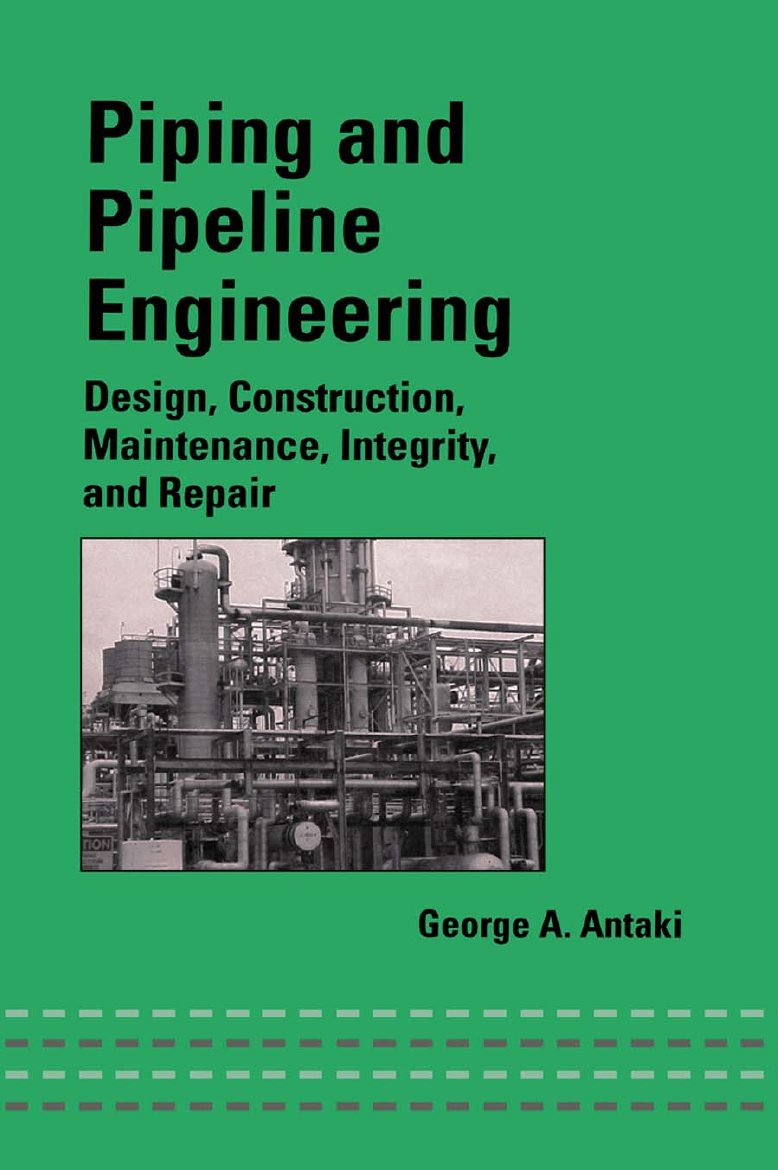
Piping and Pipeline Engineering

Offering the fundamental information for successful piping and pipeline engineering, this book pairs real world practice with the underlying technical principles in materials, design, construction, inspection, testing, and maintenance. It covers codes and standards, design analysis, welding and inspection, corrosion mechanisms, fitness-for-service and failure analysis, and an overview of valve selection and application. This volume features the technical basis of piping and pipeline code design.
Written by: George A. Antaki
No. of pages: 217
Download link is below post in First comment
Don't forget to leave your comment

Friday, August 30, 2013

Thermal and Catalytic Processes in Petroleum Refining

The book is essentially the application of reaction and reactor engineering to petroleum refining and steam cracking along with descriptions of current technology. As a result it is a great reference for chemical engineers working in the petroleum refining and petrochemical industries or for those teaching reactor engineering who would like to include examples from petroleum refining.

Written by: Serge Raseev
No. of pages: 920
Examines the thermal and catalytic processes involved in the refining of petroleum, including ` visbreaking, coking, pyrolysis, catalytic cracking, oligomerization, alkyl hydrofining, hydrocracking, and catalytic reforming.
Download link is below post in First comment
Don't forget to leave your comment


Monday, August 19, 2013

Fundamentals of gas natural processing

To help the reader understand the need of each processing step, the book follows the gas stream from the wellhead to the market place. The book focuses primarily on the gas plant processes. Wherever possible, the advantages, limitations, and ranges of applicability of the processes are discussed so that their selection and integration into the overall gas plant can be fully understood and appreciated. The book compiles information from other books, open literature, and meeting proceedings** to hopefully give an accurate picture of where the gas processing technology stands today, as well as indicate some relatively new technologies that could become important in the future. An invaluable contribution to the book is the insight provided to the authors by experts in certain applications.

Written by: Zhangxin Chen, Guanren Huan, Yuanle Ma
No. of pages: 429
Download link is below post in First comment
Don't forget to leave your comment

Friday, July 5, 2013

Valves, Piping and Pipelines Handbook, Third Edition

Over recent years, a number of significant developments in the application of valves have taken place: the increasing use of actuator devices, the introduction of more valve designs capable of reliable operation in difficult fluid read.freeduan.com handling situations; low noise technology and most importantly, the increasing attention being paid to product safety and reliability. Digital technology is making an impact on this market with manufacturers developing intelligent (smart) control valves incorporating control functions and interfaces.
New metallic materials and coatings available make it possible to improve application ranges and reliability. New and improved polymers, plastic composite materials and ceramics are all playing their part. Fibre-reinforced plastic pipe systems, glass-reinforced epoxy pipe systems and the traditional low-cost polyester pipe systems have all undergone sophisticated design and manufacturing technology changes. The potential for growth and expansion of the industry is huge.

Written by: Anatoliy Zolotukhin, Jann Rune Ursin
The 3rd Edition of the Valves, Piping and Pipelines Handbook salutes these developments and provides the engineer with a timely first source of reference for the selection and application of Valves and Pipes.
Download link is below post in First comment
Don't forget to leave your comment

Tuesday, June 11, 2013

Handbook of petroleum refining processes

Thoroughly revised and expanded by 50%, this edition of this handbook offers petroleum and chemical engineers a comprehensive guide to all aspects of petroleum refining processes. The book features new chapters from Chevron, Mobil, Shell, Exxon, UOP, and Texaco which define technology, pollution-control, and economic aspects of 60 petroleum refining processes. Each chapter covers the process chemistry and thermodynamics, product and by-product specification of all plants. Also presented are estimates of capital and operating costs, and information on the design of additions to existing refineries and construction of new ones.
Written by: Robert A. Meyers
Download link is below post in First comment
Don't forget to leave your comment

Saturday, May 18, 2013

Practical Natural Gas Engineering

The objective of the Practical Natural Gas Engineering is to bridge the gap between the engineering and the science of natural gas by publishing explicitly written articles intelligible to scientists and engineers working in any field of natural gas science and engineering from the reservoir to the market.
Written by: R. V. Smith.
An attempt is made in all issues to balance the subject matter and to appeal to a broad readership. Practical Natural Gas Engineering covers the fields of natural gas exploration, production, processing and transmission in its broadest possible sense. Topics include: origin and accumulation of natural gas; natural gas geochemistry; gas-reservoir engineering; well logging, testing and evaluation; mathematical modelling; enhanced gas recovery; thermodynamics and phase behaviour, gas-reservoir modelling and simulation; natural gas production engineering; primary and enhanced production from unconventional gas resources, subsurface issues related to coalbed methane, tight gas, shale gas, and hydrate production, formation evaluation; exploration methods, multiphase flow and flow assurance issues, novel processing (e.g., subsea) techniques, raw gas transmission methods, gas processing/LNG technologies, sales gas transmission and storage. The Practical Natural Gas Engineering will also focus on economical, environmental, management and safety issues related to natural gas production, processing and transportation.
Download link is below post in First comment
Don't forget to leave your comment

Tuesday, November 13, 2012

Surface Production Operations Volume 2

This revised edition puts the most current information about gas-handling systems and facilities at your fingertips. The authors channeled their classroom and field experience into this volume, which features many new sections such as:

* Heat recovery units
* Kinetic inhibitors and anti-agglomerators
* Trays and packing for distillation and absorption towers
* Compressor valves
* Foundation design considerations for reciprocating compressors
* Pressure vessel issues and components 
* Nox reduction in engines and turbines
* Safety management systems

This book walks you through the equipment and processes used in gas-handling operations to help you design and manage a production facility. Production engineers will keep this volume on the desktop for the latest information on how to DESIGN, SPECIFY, and OPERATE gas-handling systems and facilities. The book allows engineers with little or background in production facility design to easily locate details about equipment, processes, and design parameters. With this volume, you will more completely comprehend the techniques of handling produced fluids from gas wells so your facility can be more efficient and productive.

Download links is below post in First comment
Don't forget to leave your comment

Saturday, November 10, 2012

Surface Production Operations Volume 1

The latest edition of this best-selling title is updated and expanded for easier use by engineers. New to this edition is a section on the fundamentals of surface production operations taking up topics from the oilfield as originally planned by the authors in the first edition. This information is necessary and endemic to production and process engineers. Now, the book offers a truly complete picture of surface production operations, from the production stage to the process stage with applications to process and production engineers. 

· New in-depth coverage of hydrocarbon characteristics, the different kinds of reservoirs, and impurities in crude.
· Practical suggestions help readers understand the art and science of handling produced liquids.
· Numerous, easy-to-read figures, charts, tables, and photos clearly explain how to design, specify, and operate oilfield surface production facilities.

Find last Comment by Petropedia for working download link
Don't Forget to Leave your Comment

Share

Twitter Delicious Facebook Digg Stumbleupon Favorites More

Search This Blog

Loading

Subscribe via email

button_subscribenow.png (314×89) Learn petro engineering daily

Find Us on Facebook: